

 |
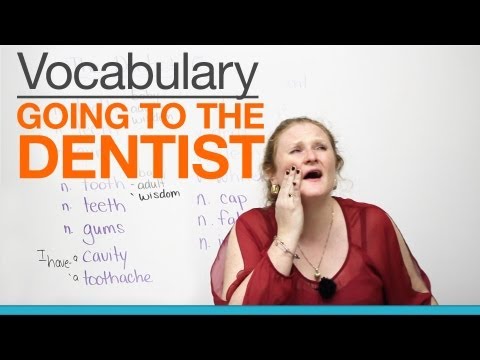
http://www.engvid.com/ Do you hate going to the dentist? I LOVE going to the dentist! The dentist is a doctor for your teeth. In this English vocabulary lesson, you'll learn lots of words that you will hear at the dentist's office. I'll teach you the words for different parts of your mouth, problems you can have with them, and some of the tools the dentist will use to fix them! Don't forget to brush your quiz and to take the teeth. Oops, I mean brush your teeth and take the quiz. http://www.engvid.com/speaking-english-dentist/
TRANSCRIPT
What's wrong? Yeah, I know. I have a toothache. It hurts. I have to go to the dentist. What's a "dentist"? A "dentist" is a tooth doctor. Do you hate going to the dentist? I love going to the dentist. I don't know why. Ever since I was a child, I have absolutely loved going to the dentist. Maybe because my dentist gave me stickers to play with or something to take home, I don't know. I've just never been afraid of the dentist. I always thought that it was really cool to see all the tools that the dentists use and put them in my mouth. I was a strange child. Not much has changed except I've gotten bigger. My name is Ronnie. Today, I'm going to teach you about going to the dentist. Oh, the torture. Oh, the pain. Oh, the fear. Oh, the fun. I'm going to teach you some basic vocabulary that you need to know if you go to the beautiful dentist.
First of all, we have English singular and plural. So, singular is one "tooth". So you can say, "My tooth hurts", or "I have a toothache" -- singular, "tooth". So "tooth" means one. If you want to talk about more than one tooth, you would say "teeth". Now, ladies and gentlemen, boys and girls, please be very careful with your pronunciation of the word "teeth" and "tooth", especially "teeth". If you do not stick your tongue out and say "teeth", it sounds like you say "tits", "tits". It sounds like you say "tits". Don't say that. So: "tooth" and "teeth". You must stick out your tongue to get the pronunciation of this word correct.
The next word you might know already, but thing this is strange, and think, "Gum? Chewing gum? What? What? What is -- dentist? Chewing? No, I don't know. I don't get it." "Gums" are basically the pink -- can you get in there? -- the pink part above your teeth. So if this is a picture of my black teeth, I have a pink tissue above my mouth -- or in my mouth
-- that surrounds my teeth like this, and these are called "gums". It is always plural. We don't say "gum". We don't say "my gum", we say "gums". So in your mouth, hopefully you have teeth. Some of you might not have all of your beautiful teeth, but that's okay. Don't worry. You have your teeth, and you have gums. So "gums" is the pink part here.
Sometimes your tooth is sore. So you might say, "Oh, my tooth is sore. I have a toothache." Say this with me: "Toothache. Toothache. I have a toothache." That means there's something wrong with your tooth. It's causing you pain. Uh-oh! Most of the time, the reason why you have a toothache is because you have a cavity -- "cavity". Now, "cavity" is simply a hole in your tooth. So this is a beautiful, red, healthy tooth, and what happens is a cavity makes a hole in your tooth, and it begins to rot right down to the root or the vein in your tooth, and that causes you pain. So a "cavity" basically just means a hole in your tooth. And because this is rotting away, it causes pain in the nerve in your mouth, causing you to get a toothache: not a good feeling, not a good situation. Unfortunately, the dentist is very expensive in Canada, so I recommend that you brush your teeth at least two times a day -- to help with the bad breath as well. You may have done a lesson on bad habits, bad breath. We don't like that. One of the reasons you may have bad breath -- or someone, not you -- is because you have a cavity.
So what you're going to do is you're going to call the dentist. You are going to make an appointment. Now, you might have noticed that I have written n-n-v-v-v-n-n-n-n-n-n-n-n; "n" means "noun". So this means it is a noun, and "v" means "verb". So what's going to happen is you're going to call the dentist's office, and you are going to "make an appointment". "Make" is a verb, so you're going to call and make an appointment. The dentist's receptionist is going to say, "tomorrow at seven." -"No." They will arrange a time for you. I know sometimes talking on the telephone is difficult, so if you can communicate with a dentist through email, or if you can actually go to a dentist office, it will be easier for you. But it doesn't matter if you call, email, or go there. You're going to make an appointment.
What's going to happen is the doctor is going to give you a check-up -- or the dentist, sorry. The tooth doctor is going to give you a "check-up". This just means he or she will check your teeth -- check if they're healthy; make sure you don't have any cavities; make sure your gums are okay. |
From:
EnglishLessons4U
Views:
123
 18
ratings |
| Time: 12:01 | More in Education |
원문출처 : http://www.youtube.com/watch?v=cbH9avLPanU&feature=youtube_gdata
댓글 0
| 번호 | 제목 | 글쓴이 | 조회 수 | 날짜 |
|---|---|---|---|---|
| 353 |
돌싱 영어로는?
 | chanyi | 887920 | 2018.07.09 |
| 352 |
애니메이션 라따뚜이로 영어회화 공부하기.
| chanyi | 884655 | 2018.01.25 |
| 351 |
나는 50문장으로 영어메일 쓴다.
| chanyi | 881406 | 2017.12.26 |
| 350 |
영어말하기필수동사 200
[1] | chanyi | 881617 | 2017.10.11 |
| 349 | 미국인이 많이 쓰는 영어 문장 500선 | chanyi | 881074 | 2017.09.26 |
| 348 | 영어회화에서 자주 사용되는 유용한 485문장 | chanyi | 880177 | 2017.09.26 |
| 347 |
텝스(Teps)어휘 320제 정리
[1] | chanyi | 879554 | 2017.05.22 |
| 346 |
한국속담을 영어로 어떻게 표현할까?
| chanyi | 2010 | 2015.12.09 |
| 345 |
자주 사용되는 영어회화 200문장
[2] | chanyi | 3470 | 2015.09.11 |
| 344 |
기초영문법-문장의 5형식
[3] | chanyi | 7180 | 2015.08.18 |
| 343 |
우리나라 회사 직책 영어표현은?
[1] | chanyi | 5942 | 2015.08.18 |
| 342 | 알아두면 좋은 영어구문 [2] | chanyi | 2336 | 2015.08.09 |
| 341 |
영문장암기 통문장
[1] | chanyi | 1630 | 2015.08.09 |
| 340 |
미국에서 하지 말아야 할 50가지
[3] | chanyi | 1915 | 2015.08.09 |
| 339 |
치약만들기 영어로 과정설명
| chanyi | 1298 | 2015.08.03 |
| 338 |
영어면접 모범답안 201개
| chanyi | 3196 | 2015.08.03 |
| 337 |
금지와 관련된 영어표현
| chanyi | 733 | 2015.08.03 |
| 336 |
영어회화 문장암기 35000개 정리자료
[2] | chanyi | 5551 | 2015.07.27 |
| 335 |
[영어회화] 야구로 배우는 영어
| chanyi | 965 | 2015.07.25 |
| 334 |
원어민이 가장 많이 쓰는 생활영어
[4] | chanyi | 1460 | 2015.07.22 |
 한국어
한국어